
Recently, Agile Robots, a global smart robot unicorn enterprise, has officially launched Agile ONE, its full-size industrial-grade humanoid robot. Engineered specifically for industrial environments, this intelligent device is powered by Physical AI at its core, enabling safe and efficient collaboration with humans and other automated systems. It marks a crucial step forward in the large-scale industrial application of humanoid robots.
As the global manufacturing industry accelerates its shift toward intelligence and flexibility, humanoid robots, serving as a vital bridge connecting artificial intelligence and the physical world, are emerging as a core driver unlocking a trillion-level market. According to forecasts by the International Federation of Robotics (IFR), the global industrial robot market is expected to reach 10 million units by 2030, with humanoid robots projected to account for over 15% of the total.
"At Agile Robots, we believe the next industrial revolution will be driven by Physical AI — intelligent, autonomous and flexible robots that can perceive, understand and act upon the physical world. Agile ONE perfectly embodies this revolution."
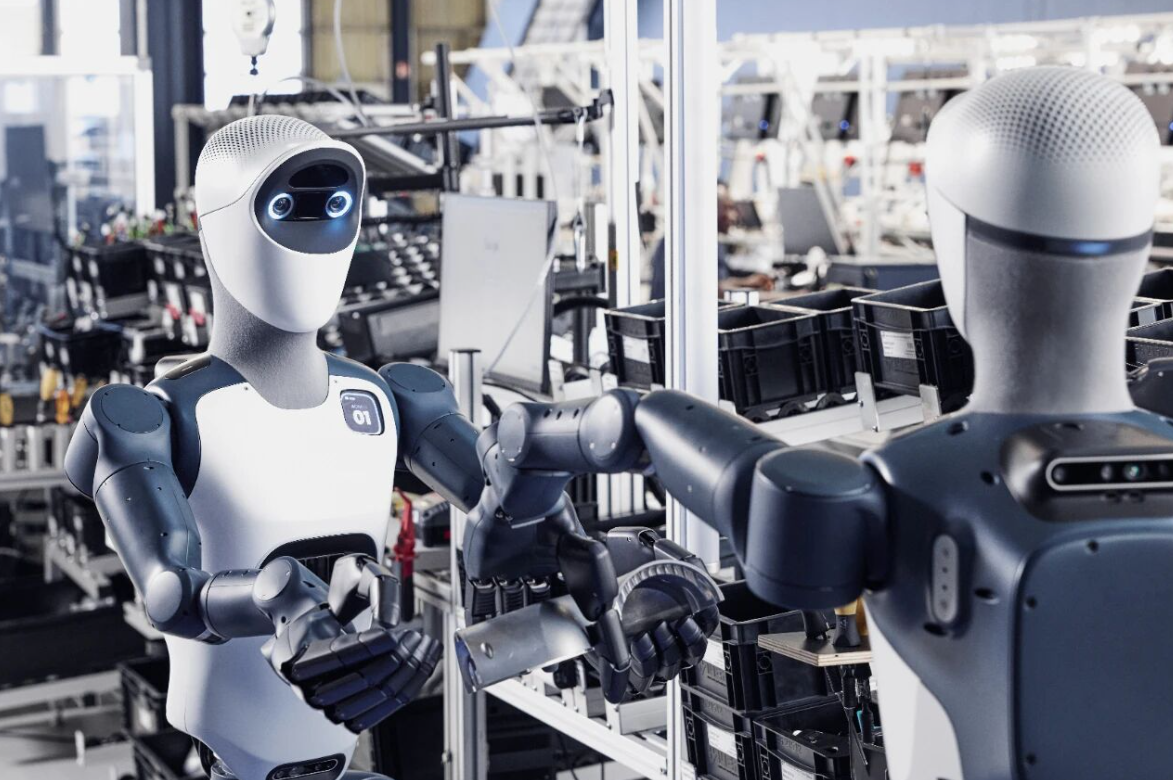
As a tangible embodiment of Physical AI, Agile ONE achieves multiple breakthroughs in core performance and practical value. Its integrated dexterous hand stands as an industry benchmark, refined based on two decades of technological accumulation by Dr. Zhaopeng Chen, Founder of Agile Robots. Every joint is equipped with torque sensors and fingertip tactile sensors, enabling it to precisely manipulate tiny screws as well as steadily operate power tools. It delivers full-scenario coverage ranging from ultra-fine manipulation to high-intensity tasks.
In terms of human-robot interaction, the robot features an innovatively designed Directional Eye Rings response system. It confirms command reception through flashing light cues. Combined with rear induction indicator lights and rear-view perception capability, it allows operators to intuitively monitor the robot’s operating status and build a safe and reliable collaborative environment.
Notably, it adopts a layered AI architecture that integrates step-by-step planned "slow thinking", dynamically responsive "fast thinking", and a high-frequency fine-tuning precision control layer. Mimicking human instinctive reactions and complex decision-making mechanisms, the robot can adaptively adjust operational force and posture to prevent objects from slipping or being damaged. This technological breakthrough greatly enhances its environmental adaptability in real industrial scenarios.
